What counts as a commercial roof emergency in Cool Creek?
An emergency is any roof condition that is actively letting water into the building or threatening to within hours. That includes a punctured membrane after a hailstorm, lifted flashing after high winds, a split seam on an aging EPDM field, a collapsed parapet cap, or ponding water that has finally found a weak spot above a tenant space. If water is reaching insulation, decking, or interior finishes, the situation is time sensitive. Slow drips from a known issue can sometimes wait for a scheduled visit, but anything pouring, spreading, or affecting electrical, IT equipment, or stock should be treated as urgent.
Cool Creek buildings see a specific mix of stressors: freeze thaw cycles that open old seams, summer thunderstorms that drive rain sideways under flashing, and hail that bruises single ply membranes without leaving obvious holes. Each of these creates a different emergency profile, and the response changes accordingly.
Property type also shapes what counts as an emergency. A distribution warehouse with palletized inventory has a different risk profile than a medical office with sensitive equipment or a restaurant with a live hood and gas lines below the roof deck. We ask about the use of the space underneath the leak because that drives how aggressively we stage the response. A drip over a concrete floor in an unoccupied bay can wait a few hours for safe access. A drip over a server rack or a stocked retail floor cannot.
How does Cool Creek Metal Roofing triage a call at 3 a.m.?
The first thing we do is ask questions. Where is the water coming in, how fast, and what is underneath it? Is the roof safe to walk in current conditions? Are tenants or staff in the building? Based on your answers, we assign a severity level over the phone and decide whether the right first move is dispatching a crew with tarps and sealant, walking you through containment steps inside the building while we mobilize, or scheduling a first light inspection if it is unsafe to climb in lightning or high wind.
That phone conversation matters. A clear picture saves time on arrival, and it lets us bring the right materials. A punctured TPO roof needs different supplies than a brick parapet that lost its coping. If you want to read more about how we handle active leaks specifically, our commercial roof leak repair overview walks through the field process in more detail.
We also coach you through what to do before we arrive. Move inventory and electronics out of the drip zone, kill power to affected circuits if water is near fixtures or panels, place buckets with towels to reduce splash, and photograph everything for the claim file. These small steps reduce loss and give the crew a cleaner work area when they get on the roof.
Can the temporary repair last until a permanent fix?
A well executed dry in can hold for weeks or longer, depending on weather. The goal is to keep the building dry while we order materials, coordinate with your insurance, and schedule the permanent scope. We re inspect after major weather events, and we tell you if the temporary work is degrading. A roof emergency is not done when the leak stops. It is done when the assembly is back to a watertight, long term condition.
How does insurance handle emergency roof repair?
Most commercial policies cover sudden, accidental damage like storm or hail events. They generally do not cover wear and tear, deferred maintenance, or failures from clogged drains. Carriers also expect the policyholder to mitigate, meaning you are required to stop ongoing damage as soon as practical. Emergency tarping and dry in are almost always covered as mitigation, even before adjuster review, as long as you keep documentation.
We provide itemized invoices, field photos, moisture maps, and a written narrative your adjuster can work with. If you want background on the documentation side, our notes on filing a water damage insurance claim apply directly to commercial roof losses as well.
One detail that catches owners off guard is the policy language around recoverable depreciation and code upgrades. If the carrier depreciates the roof based on age, you may recover that amount once the permanent repair is completed and invoiced. Code upgrade coverage, when included, can pay for items like added insulation thickness or improved fastening patterns that current code requires but the original roof did not have. We flag these line items in our scope so nothing is left on the table.
What should building owners do before the next storm?
The best emergency call is the one you never have to make. Twice yearly inspections, kept current drain and scupper cleaning, and a documented roof history give us a head start when something does go wrong. If we already know your membrane type, age, and weak points, triage at 3 a.m. is faster and the repair is more accurate. Keep a simple folder with the original roof spec, any warranty paperwork, prior repair invoices, and recent inspection photos. When you call Cool Creek Metal Roofing, having that information ready can shorten the path from first ring to a dry building considerably.
What does emergency commercial roof repair cost in Cool Creek?
Pricing depends on roof type, access, square footage of the affected area, and whether the visit is stabilization only or includes permanent repair. Here is a realistic range for typical Cool Creek commercial work:
If the failure points to broader system fatigue, you may be looking at a larger conversation about full commercial roof repair scope or eventual replacement. We will tell you directly if a patch is just buying time.
What does the crew actually do on arrival?
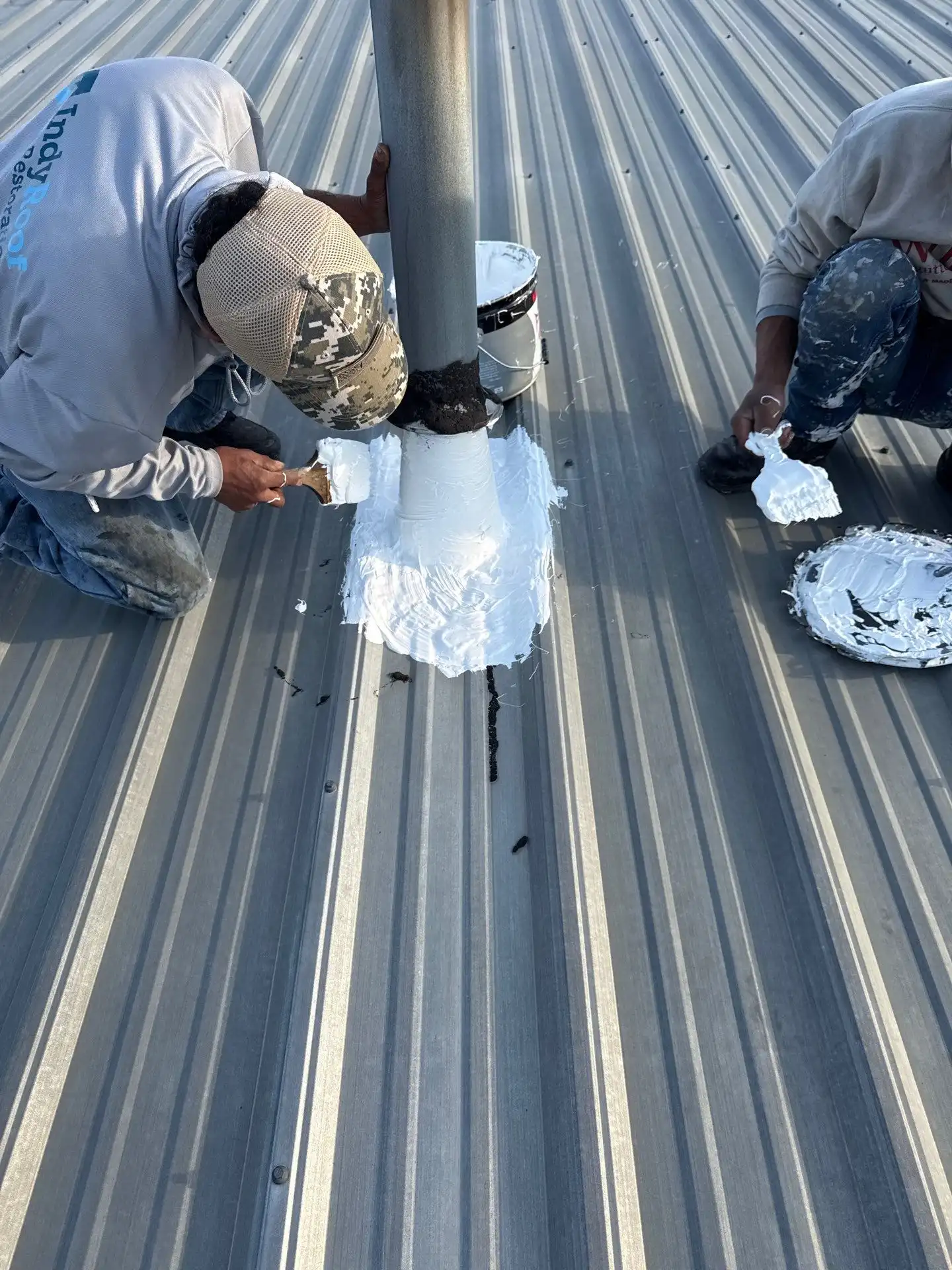
Step one is always stopping the water. For most active leaks that means a temporary dry in: shrink wrap tarping, peel and stick membrane patches, sealant over splits, or a fully adhered patch over punctures. For ponding situations we may pull a drain clog or cut a controlled relief point. For lifted flashing we re secure and seal the perimeter so wind cannot peel it further before a permanent fix.
Step two is documenting everything. Photos of the failure point, moisture readings on the deck and insulation, and notes on contributing factors like clogged scuppers or failed pitch pans. This record matters for your insurance claim and for the permanent repair scope. Step three is a written summary of what we did, what is still at risk, and what the next visit should include.
Crews also walk the broader roof field while they are up there. A leak above the office may be entering through a failed seam thirty feet away, and that water can travel along the underside of the membrane or across the deck before it shows up inside. Finding the true entry point, not just the interior drip location, is the difference between a repair that holds and a repair that fails the next time it rains hard.